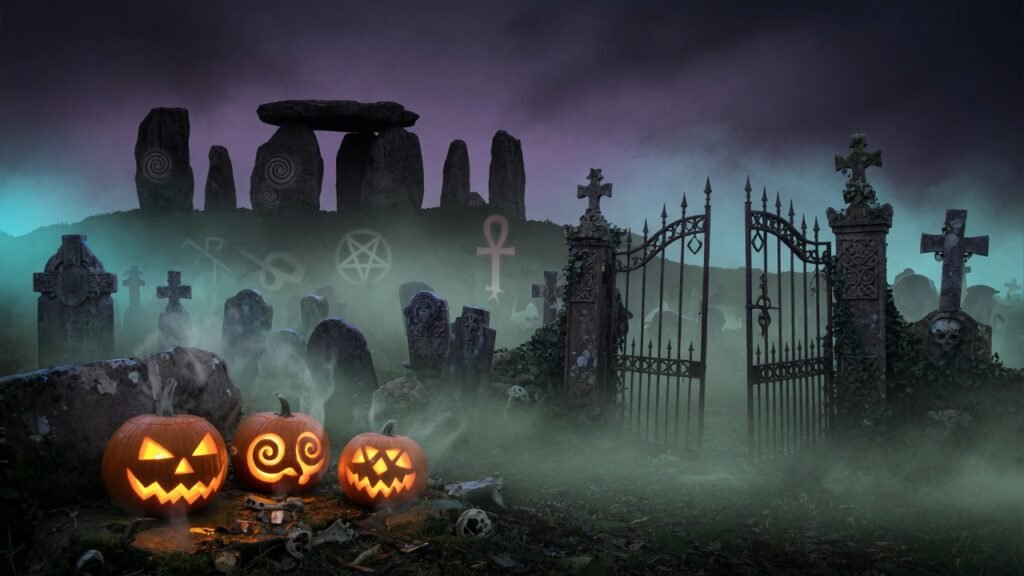
Halloween has long been celebrated as a night of costumes, trick-or-treating, and spooky fun. But beneath the layers of sugar-coated excitement lies a much darker narrative—one steeped in ancient rituals involving torture, abuse, and a hidden agenda that grants power to the devil himself. Let’s dig beneath the candy wrappers and plastic masks to uncover the real meaning of Halloween and why some people are convinced that by celebrating it, we are unwittingly empowering dark forces.
The Pagan Roots and the Devil’s Mask
The real history of Halloween reveals how the truth about Halloween has been distorted, transforming what was once a dark and sinister event into a seemingly innocent night of fun and festivities. The original meaning, which revolved around invoking the spirit world and appeasing dark entities, has been masked by the commercialisation of costumes, decorations, and sweets. This deliberate shift in perception has made it easier for the true, sinister nature of Halloween to be forgotten, allowing people to participate without understanding the darker forces at play.
Halloween is just one of several key dates on which ritualistic sacrifices are said to take place. These sacrifices occur during other significant times of the year, such as Beltane (30 April–1 May), Walpurgis Night (30 April), and the summer solstice. Reports on ritual sacrifices indicate that these dates are chosen for their unique spiritual power. These dates, like Halloween, hold unique spiritual power, which is why they are chosen for dark rituals. Throughout history, these occasions have often been marked by human and animal sacrifices intended to invoke and appease demonic entities, gaining supernatural power in return.
Elite secret societies, such as the Illuminati, are said to engage in ritualistic human sacrifices on particular dates to harness power. These ceremonies are timed with specific astrological events or dates of historical significance, including Halloween, to maximise the power and energy gained. These rituals are thought to serve the purpose of maintaining control, invoking demonic forces, and feeding dark spiritual energies that empower those involved. Conspiracy theories regarding the Illuminati often mention these dark ceremonies and their role in gaining power and influence.
Halloween traces its roots back to the ancient Celtic festival of Samhain, a sacred event marking the end of the harvest season and the onset of winter. The Celts believed that on 31 October, the veil between the world of the living and the dead was at its thinnest, allowing spirits to roam the earth. People would light bonfires and dress in costumes to ward off evil entities. Although Samhain itself wasn’t inherently sinister, it was deeply connected with the supernatural, blurring the lines between this world and the next.
The ancient Celts also engaged in rituals that included sacrifices to appease the spirits. These sacrifices sometimes involved the brutal killing of animals, and there are accounts suggesting that human sacrifices were performed as well. The aim was to gain favour with the spirits and ensure protection from malevolent forces. Such acts of torture and abuse were an integral part of the darker aspects of Samhain, embedding fear and submission into the fabric of the celebration.
Human sacrifice was not unique to the Celts. Around the world, various cultures practised human sacrifice as a way to gain favour with supernatural forces. From the Mayan and Aztec cultures, where human sacrifices were conducted atop towering pyramids to appease the gods, to ancient Mesopotamian rituals, the act of taking a life for spiritual gain has been a recurring theme in human history. These dark practices have often been tied to power and control, with sacrifices seen as a way to harness supernatural influence. This practice is said to continue today in secret, particularly among certain elite groups like the Illuminati, who engage in these rituals to consolidate their power and influence.
Human sacrifice was believed to be one of the most potent offerings to appease the spirits. Historical records and accounts from ancient times describe how some individuals, often captives or those considered outsiders, were ritually killed during Samhain. These sacrifices were deemed necessary to ensure the survival of the community during the harsh winter months. The belief was that by offering human lives, the Celts could gain the favour of powerful spirits and deities, thereby protecting their crops, livestock, and families from misfortune.
As Christianity spread, the Church sought to replace pagan celebrations with its own holy days. Thus, Samhain morphed into All Hallows’ Eve, eventually becoming the Halloween we know today. Yet, beneath this veneer of Christianity, the true essence of Halloween has never changed. It is still about the dead, still about invoking the spirit world, and still about giving power to something beyond our understanding.
Anton LaVey and Halloween’s Satanic Undertones
To understand how Halloween might be empowering the devil, we must consider the words of Anton LaVey, founder of the Church of Satan. LaVey openly acknowledged Halloween as an important holiday for Satanists. He saw it as an opportunity for people to indulge in their darkest fantasies, wear masks that reveal their hidden nature, and celebrate the thrill of the forbidden. In LaVey’s view, Halloween was a night when even non-Satanists played along with devilish imagery and unconsciously engaged in acts of rebellion against traditional morality and spirituality.
Anton LaVey founded the Church of Satan in 1966, and his teachings emphasised the importance of individualism, indulgence, and the rejection of conventional religious morality. He believed that humans are inherently carnal and that embracing one’s desires is a path to personal freedom. Church of Satan history details how LaVey viewed Halloween as a perfect representation of these ideas—a night when people could let go of societal expectations and reveal their true selves, often masked and hidden throughout the year.
LaVey’s promotion of Halloween as a celebration for Satanists was not just about the fun of costumes and spooky imagery. It was about reclaiming the aspects of human nature often suppressed by religious and societal norms. For LaVey, Halloween represented a rejection of guilt and fear associated with traditional morality. Instead, it was a time to embrace the darker aspects of human nature without shame or restraint. This alignment with indulgence, rebellion, and the occult is why LaVey considered Halloween significant for Satanists.
“I’m glad that Christian parents let their children worship the devil at least one night out of the year,” LaVey is famously quoted as saying. This statement highlights what many believe to be the real agenda behind Halloween—the normalisation of dark imagery, the celebration of fear, and ultimately, the empowerment of evil. By embracing the symbols and activities associated with Halloween, people are unknowingly giving power to the forces that oppose goodness and light.
Energy, Intent, and the Devil’s Power
A key aspect of Halloween is the idea that energy and intent matter more than people realise. Halloween is not just about costumes and sweets; it is a night of collective energy focused on the macabre, the sinister, and the supernatural. The idea is that by channelling so much collective attention toward themes of death, fear, and horror, people are effectively giving power to dark forces. The rituals—however innocent they may seem—are believed to energise and empower the devil, making Halloween a mass occult ceremony in disguise. Occult symbolism in Halloween discusses how these activities are contributing to a larger occult agenda.
Consider the symbols used during Halloween—pentagrams, witches, ghosts, and skulls. These symbols are not random; they are steeped in meaning and ritualistic power. By decorating homes with these symbols, donning costumes that embody the dark and supernatural, and even partaking in activities like divination or ouija boards, people are invoking forces they do not fully understand. The argument is that these actions, even if performed in ignorance, still contribute to a larger scheme of spiritual influence, subtly shifting our culture away from positive spiritual values.
Are We Unwitting Participants?
For many, Halloween is nothing more than harmless fun—a chance to dress up, eat sweets, and watch scary films. But for others, it is a night that encourages people to embrace darkness rather than light. The commercialisation of Halloween has effectively obscured its origins, and as a result, few people are aware of the energies they may be invoking. Everyone who celebrates Halloween is unknowingly giving power to the devil, and the collective focus on fear, death, and the occult feeds into a broader agenda that ultimately glorifies the forces of darkness.
Conclusion: Choosing Light or Darkness
Expose The Origin of Halloween I
“We are quick on our feet to rush and honour the devil in so many ways. We see no harm in Halloween because we think it is fun. We paint our faces, wear our innocent costumes, and dress up our doorways—even churches dress up their entryways for Halloween with pumpkins. These actions are like giving the devil licence, saying, ‘Here’s my church. You can have it.’
We think that because we are not performing any demonic rituals or human sacrifices, we are on safe ground. But did you know that as soon as you dress up, whether you colour yourself or put on a costume, the enemy owns you? Because by doing so, you have turned over your legal rights, and you have dedicated yourself and your kids to celebrating the devil’s holiday. You have just made a pact with the enemy, and you are already sacrificing your children spiritually by dressing them up and changing their identity.”
—Former Satanic High Priest & Redeemed Evangelist John Ramirez http://johnramirez.org
Whether you see Halloween as an innocent celebration or as something more sinister, it’s worth considering the energy behind the actions. Are we simply having fun, or are we contributing to a tradition that, at its core, has always been about the interplay between light and darkness? Anton LaVey’s endorsement of Halloween as a Satanic holiday should give us pause. The symbols we use, the stories we tell, and the rituals we engage in all have power—and perhaps it’s worth thinking about whether that power is something we truly wish to give.
Ultimately, the choice is up to each individual. But understanding the origins and the possible deeper meanings behind Halloween may help us decide if it’s a night we want to celebrate, or one we should approach with caution.
Continue the trail
Related dossiers
Schools, Prisons, Libraries and Bookstores
CLASSIFIED DOSSIERERIC DUBAY ARCHIVE Schools, Prisons, Libraries and Bookstores — restored from the Eric Dubay library for this archive. Claims preserved; presentation…
Open dossier →
The Nuclear Hoax
CLASSIFIED DOSSIERERIC DUBAY ARCHIVE The Nuclear Hoax — restored from the Eric Dubay library for this archive. Claims preserved; presentation rewritten for…
Open dossier →
The Truth About Hitler
CLASSIFIED DOSSIERERIC DUBAY ARCHIVE The Truth About Hitler — restored from the Eric Dubay library for this archive. Claims preserved; presentation rewritten…
Open dossier →