
Throughout history, ancient wisdom has been cloaked in allegory, mysticism, and religious symbolism. Among the most intriguing and enigmatic of these teachings is the concept of “Raising the Chrism” — a practice tied to the sacred energy believed to reside within each individual. This esoteric principle, often veiled behind religious and spiritual texts, is said to unlock profound transformations of the mind, body, and spirit. But what is the chrism, and why has its significance been obscured from mainstream understanding?
Table of Contents
The Christ Within: Allegory and Symbolism
The concept of raising the chrism is deeply interwoven with the story of Christ. In esoteric traditions, the narrative of Jesus Christ is seen as an allegory for the spiritual journey within each individual. The descent, crucifixion, and resurrection of Christ mirror the process of raising the chrism:
- The Descent
The chrism descends from the brain (the “heavens”) into the sacrum, mirroring the story of Christ coming to Earth. This represents the potential for spiritual transformation seeded within each human. - The Crucifixion
At the base of the spine, the chrism lies dormant, awaiting activation. The “crucifixion” symbolizes the struggle of overcoming earthly desires and lower vibrations to prepare for spiritual ascension. - The Resurrection
Through practices like meditation, fasting, breathwork, and living in alignment with higher virtues, the chrism is said to rise back up the spine, illuminating the pineal gland (the “third eye”) and activating divine consciousness. This “resurrection” aligns the individual with the Christ consciousness — a state of unity, love, and higher awareness.
Jacob’s Ladder: The Brain, the Spine, and Finding God Within
The journey of raising the chrism is often symbolized by Jacob’s Ladder, a metaphor found in many mystical traditions. In the biblical story, Jacob dreams of a ladder reaching from Earth to Heaven, with angels ascending and descending upon it. This ladder is a powerful symbol of the human spine, which serves as a conduit for spiritual energy to rise from the base of the spine to the higher centers of the brain.
The spine, with its thirty-three vertebrae, represents the steps of Jacob’s Ladder, symbolizing the ascent of consciousness through each stage of spiritual growth. The number thirty-three is also significant because it is the age at which Jesus is said to have undergone the crucifixion, representing the culmination of spiritual transformation.
Different areas of the brain play vital roles in this process:
- Claustrum
The claustrum is believed to be the starting point of the sacred secretion, the chrism. It is often referred to as the “seat of consciousness” and is thought to play a role in the connection between mind and spirit. From the claustrum, the chrism descends to the spinal column. - Pituitary and Pineal Glands
As the chrism rises through the spine, it eventually reaches the brain, where it activates the pituitary and pineal glands. The pituitary gland, often associated with the “sacred feminine,” and the pineal gland, associated with the “sacred masculine” and the “third eye,” work in harmony to elevate consciousness. The activation of the pineal gland is thought to open the “third eye,” leading to heightened intuition and spiritual vision. - Thalamus and Corpus Callosum
The thalamus is often seen as the gateway to higher consciousness. When the chrism energy activates the thalamus, it allows for a deeper connection to the divine within. The corpus callosum, which connects the two hemispheres of the brain, is believed to play a role in integrating the dual aspects of the self, leading to a unified state of awareness.
Jacob’s Ladder, therefore, represents the process of raising the chrism up the spine, each vertebra being a step toward divine consciousness. The brain, with its different areas, serves as the “promised land” where the ultimate union with the divine takes place. This process is a journey within, symbolizing the individual’s quest to find God not in the external world but within their own consciousness.
Churches as Ancient Power Stations: Frequency and Repurposing
There is a growing theory that many ancient churches and cathedrals were originally designed as power stations or frequency generators, harnessing and amplifying natural energies for spiritual and physical benefits. These structures were built with such precision that they appeared to function as “batteries” of sorts, utilizing sacred geometry, ley lines, and specific building materials to generate and channel frequencies.
Many of these buildings were constructed at key energetic points on Earth — known as ley lines — where the planet’s natural electromagnetic energy is particularly strong. The tall spires and towers of churches were not just ornamental but acted as antennas, drawing in and radiating energy. The use of materials like granite, which has piezoelectric properties, helped in amplifying these energies.
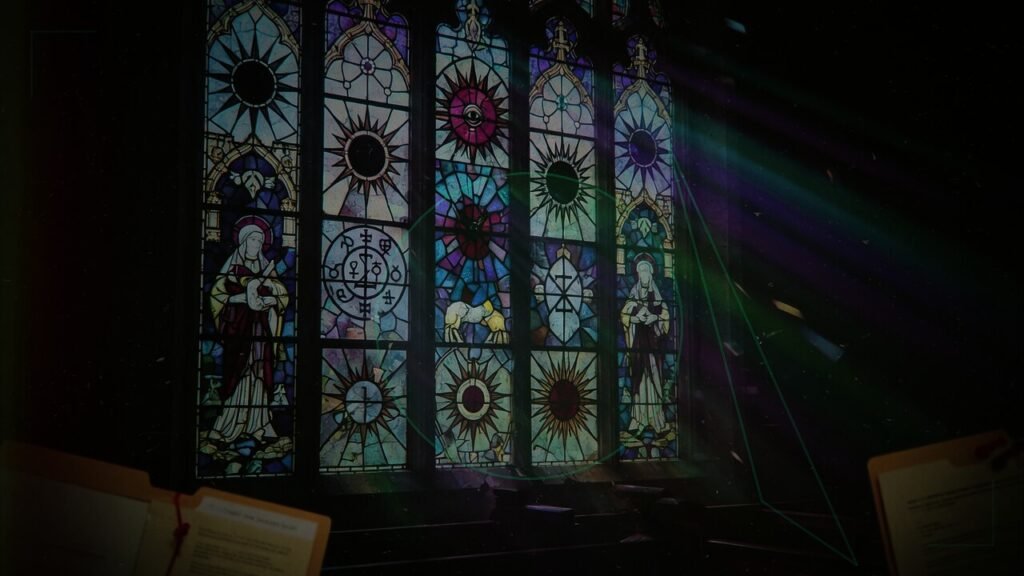
The interiors of these structures, with their high vaulted ceilings, stained glass windows, and resonant chambers, were designed to create specific acoustic effects. Chanting, singing, and even the vibration of organ music could generate frequencies that influenced the body’s energy centers, aiding in spiritual elevation and the raising of the chrism. These frequencies could help align and activate the chakras, including the all-important pineal gland or “third eye.”
Over time, however, these ancient power stations were repurposed. The original intent of these buildings — to serve as places of energetic transformation and spiritual empowerment — was largely lost as organized religion took hold. The architectural features that once served to uplift and transform the individual were instead used to evoke awe and submission to religious authority. The natural energetic properties of these sacred spaces were ignored or actively suppressed, and the buildings were used primarily for ritual and ceremony designed to reinforce the externalization of spiritual power.
The repurposing of these ancient energy centers into places of control rather than empowerment is yet another example of how the elite sought to divert humanity’s potential for inner growth. By transforming these power stations into conventional places of worship, the focus shifted from personal spiritual experience to obedience and the glorification of religious institutions.
Suppression of the Sacred Secret
Why is the concept of raising the chrism so obscure? Many theorists believe this knowledge was deliberately hidden by religious and political powers. They suggest that institutions such as the Church sought to externalize spirituality, teaching followers to seek salvation through external rituals and authority figures rather than through inner work.
Religious cults have deliberately altered meanings, rewritten sacred books, and transformed this once widely taught knowledge. They replaced it with the notion of an external “man in the sky” — often mockingly referred to as “sky daddy.” This shift has discouraged people from looking within for the divine, instead directing their attention to a far-off deity who must be appeased through intermediaries.
By keeping the sacred science of raising the chrism secret, these institutions maintained control, ensuring that individuals remained dependent on external guidance rather than realizing their inherent divinity.
Historical figures like the Gnostics and Essenes, who emphasized inner spiritual practices, were often persecuted for their teachings. Similarly, mystical traditions like Kabbalah, Hermeticism, and Alchemy, which explore similar principles, were pushed to the fringes of society.
The Gnostics, in particular, were a significant target of religious suppression. They believed that the divine spark was within every individual and that salvation came through gnosis, or direct knowledge of the divine, rather than adherence to dogma. Their teachings highlighted the inner journey and the importance of self-realization, concepts that directly challenged the authority of organized religious institutions. As a result, Gnostic texts were systematically destroyed, and their followers were labeled heretics.
The Essenes, another mystical sect, also taught the importance of inner purity and spiritual awakening. They practiced asceticism, meditation, and a form of communal living that emphasized the cultivation of the spirit. Their teachings, much like those of the Gnostics, focused on the individual’s connection to the divine within. These teachings were seen as a threat to the emerging religious power structures that sought to centralize spiritual authority.
The hidden hands of the elite — political rulers and religious authorities — played a pivotal role in transforming the original spiritual teachings into doctrines that served their interests. By shifting the focus from the internal to the external, they ensured that people would seek salvation through the Church and its intermediaries rather than realizing their own power. This externalization of spirituality created a population that was easier to control, as individuals were taught to look outward for answers, rather than within.
The deliberate alteration of sacred texts can also be traced back to the Council of Nicaea in 325 AD, where early Church leaders decided which books would be included in the Bible and which would be excluded. Many esoteric teachings that emphasized the inner journey were left out, deemed heretical, or reinterpreted to fit the narrative that served the Church’s authority. This council marked a turning point in the way Christianity was taught and practiced, moving away from the mystical, individualized path to a more dogmatic, institutionalized religion.
Mystical traditions such as Kabbalah, Hermeticism, and Alchemy, which also contained knowledge of raising the chrism and unlocking the divine potential within, were similarly suppressed. These traditions were often forced underground, practiced in secret to avoid persecution. Alchemy, for example, was not just about transforming base metals into gold; it was a symbolic practice representing the transformation of the individual from a base, earthly state to a higher, divine state. The elite, however, branded such practices as occult and dangerous, further alienating people from their true potential.
The Science of Raising the Chrism
In addition to its spiritual implications, raising the chrism is said to have physical and mental health benefits. Modern science offers intriguing parallels:
- Pineal Gland Activation
The pineal gland, often associated with the “third eye,” plays a significant role in regulating sleep, circadian rhythms, and melatonin production. Practices like meditation and exposure to natural light are thought to enhance its function, promoting clarity and well-being. - Kundalini Energy
In Eastern traditions, the concept of kundalini energy — a coiled energy at the base of the spine — mirrors the chrism. When this energy rises through the chakras, it is said to lead to spiritual awakening and heightened consciousness. - Neuroscience of Breathwork and Fasting
Techniques like deep breathing, intermittent fasting, and mindfulness have been shown to reduce stress, enhance neuroplasticity, and improve brain function. These practices align with ancient methods for cultivating the chrism.
How to Raise the Chrism
Raising the chrism requires a disciplined approach to spiritual and physical practices:
- Meditation and Prayer: Quiet the mind to tune into the subtle energies within.
- Breathwork: Practices like diaphragmatic breathing or alternate nostril breathing stimulate energy flow.
- Clean Living: Avoiding excess alcohol, processed foods, and harmful substances purifies the body.
- Fasting: Periodic fasting supports physical detoxification and heightens spiritual sensitivity.
- Moral Integrity: Living in alignment with virtues like love, kindness, and truth elevates one’s vibration, enabling the chrism to rise.
Conclusion: Awakening the Christ Within
The concept of raising the chrism reminds us of the transformative power within. It is an ancient, sacred secret that calls humanity to transcend materialism and ego-driven lives, awakening to the divine potential that resides in each of us.
As the world shifts toward greater awareness, uncovering and practicing this lost knowledge can lead to profound personal and collective evolution. The question remains: Are we ready to embrace the Christ within and rise above the illusions of the external world?