The Self-Policing Society: Enforcing Your Own Oppression
The greatest conspiracy isn’t a shadowy cabal lurking behind closed doors—it’s a system so brilliantly crafted that the people within it willingly police themselves. In the modern world, we’ve reached a chilling peak where humans have become complicit in their own control, surveillance, and exploitation, often without even realising it.
The most insidious systems don’t rely on brute force or obvious coercion. Instead, they disguise themselves under the banners of convenience, safety, and progress. Through speed cameras, surveillance systems, advanced technologies, and regulatory frameworks, we’ve built an inescapable web of self-oppression, all while convincing ourselves that it’s for our own good.
Speed Cameras: Snitching for the System
Speed cameras are hailed as tools to reduce accidents and promote road safety, but the reality is far more sinister. In truth, speed cameras serve primarily as a revenue-generating mechanism, and the data reveals it. In 2022 alone, UK councils reportedly raked in nearly £1 billion from parking fines and speeding penalties combined. A significant portion of this income was generated by automated speed cameras, strategically placed to maximise violations rather than genuinely improve safety.
Consider the placement of speed cameras: they are often found on stretches of road where speed limits abruptly change or on downhill slopes where maintaining the posted limit is almost impossible without constantly braking. These locations are not chosen because they are accident hotspots but because they are “profitable.” For example, the infamous M4 speed cameras between London and Reading consistently catch thousands of drivers, generating millions in fines annually. Are these funds reinvested into repairing potholes, improving signage, or building safer roads? Rarely.
Moreover, speed cameras eliminate the human element in law enforcement. A police officer can exercise discretion, taking into account the conditions, context, or intent of the driver. A machine cannot. By removing human judgment, speed cameras enforce the law rigidly, punishing minor infractions while turning a blind eye to broader safety issues, such as dangerous road designs or reckless driving that isn’t speed-related.
The Compliance Mindset:
What’s even more alarming is how the public defends the proliferation of these cameras. The narrative is simple: if you oppose them, you must be reckless or irresponsible. Yet, no one questions why drivers are fined for going 33 mph in a 30 mph zone on an empty street at midnight, while those who use their mobile phones at the wheel or drive uninsured often evade detection.
The system’s brilliance lies in its ability to make citizens unwitting enforcers. Those clamouring for stricter speed enforcement are essentially advocating for their own financial punishment and surveillance. This normalisation of automated fines has paved the way for even more invasive forms of road monitoring, such as average-speed cameras and congestion charges, which further erode personal freedoms under the guise of safety and sustainability.
Surveillance Nation: Spying on Ourselves
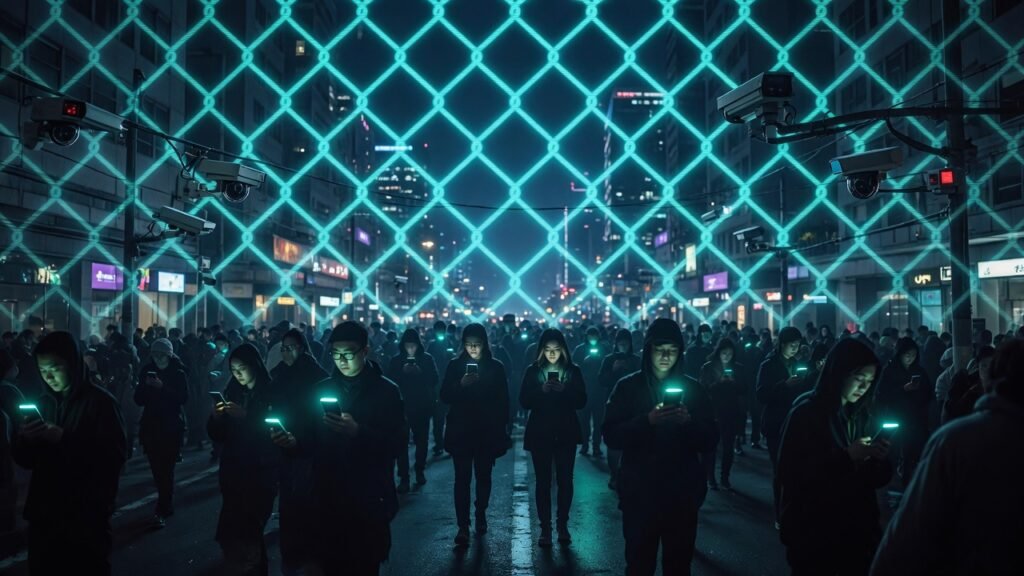
The UK is one of the most heavily surveilled nations in the world, with an estimated 5.2 million CCTV cameras in operation—approximately one for every 13 people. But here’s the twist: the majority of this surveillance is now carried out by ordinary citizens. Smart doorbells like Amazon’s Ring, home security systems, and even dashcams have transformed private homes and vehicles into extensions of the state’s surveillance network.
Consider this: footage from your doorbell camera can be shared with police forces without your explicit consent, thanks to partnerships between tech companies and law enforcement. In the UK, the Metropolitan Police and other forces have increasingly relied on footage from private cameras to monitor public spaces, raising serious privacy concerns. What starts as a measure for personal safety quickly becomes a tool for mass surveillance.
Social media adds another layer. Platforms like Facebook, Instagram, and TikTok encourage users to document and share their lives, often unwittingly providing authorities with evidence that can be used against them. In 2021, UK police reportedly used social media posts to issue fines for Covid-19 lockdown breaches, with individuals incriminating themselves through posts about gatherings or travel.
The Compliance Mindset:
The justification is always the same: “If you have nothing to hide, you have nothing to fear.” This mantra has lulled society into a false sense of security, obscuring the fact that even benign actions can be misconstrued or exploited. By participating in this culture of self-surveillance, we’re building a panopticon—a prison without walls, where the mere possibility of being watched influences behaviour.
5G: The Infrastructure of Control
The rollout of 5G technology was marketed as a revolution in connectivity and innovation, promising faster internet speeds and seamless communication. But what was left out of the glossy advertisements were the implications for privacy and control. Unlike previous generations of wireless technology, 5G supports an “always-on” environment, enabling the proliferation of the Internet of Things (IoT). This means that everything from your fridge to your car can be connected, monitored, and controlled remotely.
In the UK, the deployment of 5G has been accompanied by significant government investment, not just in infrastructure but in “smart city” initiatives. These projects include interconnected systems for traffic management, public safety, and urban planning—all underpinned by real-time data collection. While this may sound like progress, it creates a digital ecosystem where every action is trackable and every decision can be influenced by algorithms.
Whispers of Control:
There are also concerns about the health and environmental impact of 5G. Despite these being dismissed as “conspiracy theories,” several independent studies have highlighted potential risks from prolonged exposure to high-frequency electromagnetic waves. But rather than address these concerns transparently, governments and corporations double down on the narrative of progress, silencing dissent through ridicule and censorship.
ULEZ and Digital Compliance
Ultra-Low Emission Zones (ULEZ) and other environmental policies are often celebrated as victories for sustainability. But scratch beneath the surface, and their true purpose becomes clear: these schemes are about control and profit, not saving the planet.
In London, the ULEZ expansion under Mayor Sadiq Khan has faced backlash for its disproportionate impact on working-class residents. Those who can’t afford to upgrade their vehicles to meet emissions standards are forced to pay daily charges, while wealthier individuals face no such challenges. Meanwhile, private jet flights—often taken by the same elites promoting these measures—remain largely unregulated.
The system thrives on guilt. “If you don’t support ULEZ, you’re anti-environment.” This binary framing prevents meaningful debate and allows those in power to push through policies that extract wealth from ordinary people while doing little to address the root causes of environmental degradation, such as corporate pollution and unsustainable industries.
A Society of Willing Participants
The most disturbing aspect of these systems is how willingly we participate in our own oppression. Speed cameras? Safety. CCTV? Security. 5G? Progress. ULEZ? Saving the planet. The messaging is always the same: if you resist, you’re a bad person. And so, we enforce these measures on ourselves and each other, too blinded by the propaganda to see what’s really happening.
The system’s genius lies in how it weaponises morality. By framing dissent as selfish or irresponsible, it silences criticism and ensures compliance. We become not just victims but perpetrators, policing ourselves and each other in a never-ending cycle of control.
Breaking Free
To dismantle this system, we must first confront some uncomfortable truths:
- The institutions claiming to protect us are often the same ones profiting from our exploitation.
- Convenience is the bait used to trap us in systems of control.
- Progress is not always synonymous with freedom.
Ask yourself:
- Why do we accept systems that harm us while enriching the elite?
- Who benefits from our compliance?
- What price are we willing to pay for safety and convenience?
Breaking free starts with awareness. Recognise the con. Question the narratives. Refuse to comply blindly. Only then can we begin to reclaim our autonomy and dismantle the systems of control that thrive on our participation.